What is TDS in drinking water, and what does it not tell you?
TDS in drinking water explained: what total dissolved solids and ppm mean, and what a TDS meter can and cannot show.

Read a drinking water label as a whole: check the mineral composition, the TDS and pH values if provided, the manufacturer and batch details, and the condition of the cap and seal. TDS and pH are useful, but neither one proves that water is safe, so no single number should decide your choice. It also works as a quick checklist for a 5 gallon (19 litre) water bottle: check the seal, the expiry or bottling date, the minerals and sodium listed, and any storage advice.
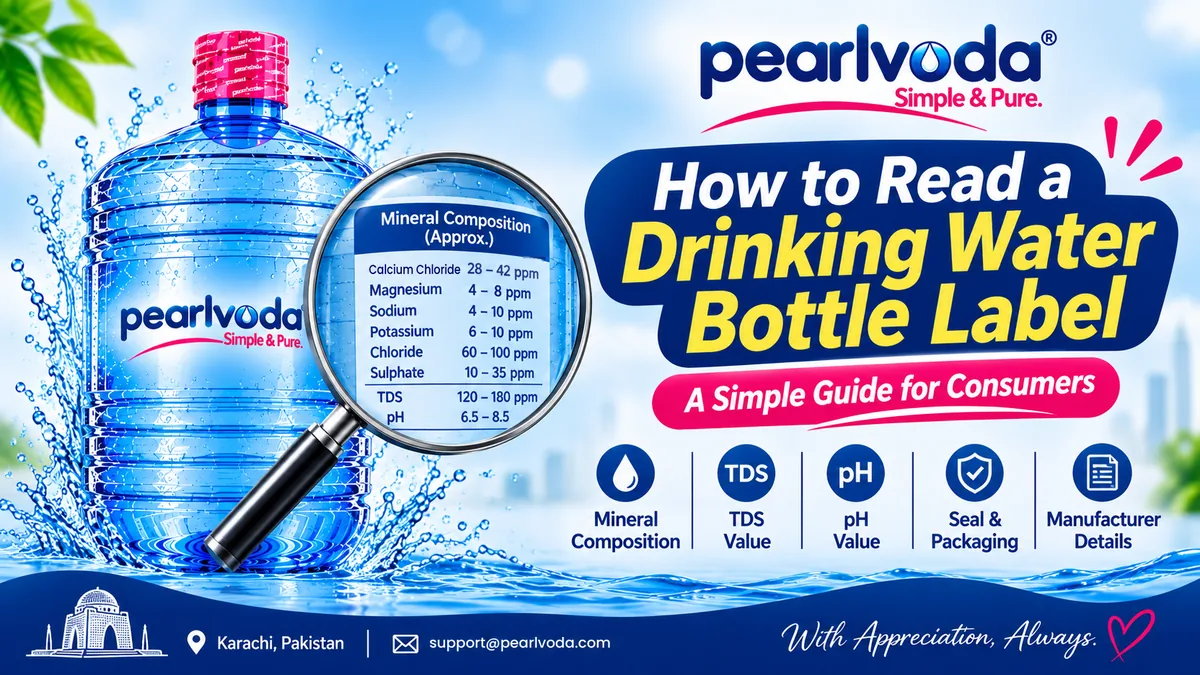
When buying drinking water, most people check the brand name, bottle size and expiry date. But there is another part worth paying attention to: the information printed on the bottle label.
A drinking water label can tell you more than just the name of the product. It may include details about mineral composition, Total Dissolved Solids (TDS), pH, manufacturing information and packaging. Understanding these details can help you make a more informed choice, especially when comparing different bottled water products in Pakistan.
Let’s break down what these numbers and terms actually mean, without making things unnecessarily technical.
A water bottle label provides useful information about the product inside. It helps consumers understand its composition, identify the manufacturer and check important product details. Instead of choosing water based only on brand appearance or a single TDS number, take a moment to look at the complete label.
Here are some details worth checking:
The exact information and labelling requirements can vary depending on the type of packaged water and the applicable standard.
One of the most useful sections of a drinking water bottle label is the mineral composition table. Water can contain dissolved minerals and salts in different amounts. These substances contribute to its overall composition and may also influence its taste.
Common minerals and dissolved substances listed on water labels include:
| Mineral or substance | What it tells you |
|---|---|
| Calcium | A naturally occurring mineral that contributes to water composition |
| Magnesium | A mineral found in many water sources |
| Sodium | An element that may be present in dissolved form |
| Potassium | Another naturally occurring mineral |
| Chloride | A dissolved ion commonly found in water |
| Sulphate | A naturally occurring dissolved ion |
These components are usually listed in parts per million (ppm) or another specified unit.
Two bottles of water can have similar TDS readings but different mineral compositions. For example, one may contain relatively more calcium and magnesium, while another may have a different balance of dissolved substances. This is why looking at the complete composition gives you more information than looking at one number alone.
TDS stands for Total Dissolved Solids. It refers to the combined concentration of dissolved substances, including minerals and salts, in water. It is commonly expressed in parts per million (ppm).
For example, if a water bottle displays a TDS value of 150 ppm, it indicates an estimated concentration of 150 parts of dissolved solids per million parts of water.
However, there is an important distinction: TDS tells you how much dissolved material is present, not whether the water is safe to drink.
A TDS meter cannot confirm the absence of harmful microorganisms or identify every possible contaminant. Two water samples can also have similar TDS readings but very different compositions. For a more complete understanding, consider the full mineral composition and appropriate water-quality test results.
If you want to understand this measurement in more detail, read our guide: What is TDS in drinking water, and what does it not tell you?
ppm stands for parts per million. It is a unit used to express the concentration of a substance in water. Think of it as a way of describing how much of a particular dissolved substance is present in a much larger amount of water.
For example:
These numbers describe the concentration of each listed component, assuming the label specifies ppm as the unit. You may see ppm next to individual minerals as well as the total dissolved solids value.
Remember that the figures for individual components should not automatically be added together to calculate TDS. Chemical reporting, overlapping measurements and the way a manufacturer presents its composition can affect how these values relate.
pH indicates how acidic or alkaline water is. The pH scale generally runs from 0 to 14:
Unlike TDS, pH is not measured in ppm. It is a separate measurement. You may find a pH value or range printed on a bottled water label. For example, a label showing a pH range of 6.5–8.5 indicates the stated pH range for that product.
It is important not to judge drinking water quality on pH alone. A pH reading does not provide information about microbiological safety or the presence of all chemical contaminants.
To make these details easier to understand, let’s look at the mineral composition published by Pearl Voda. Our Our water page shows the following values for our treated water:
| Component | Published range |
|---|---|
| Calcium Chloride | 28–42 ppm |
| Magnesium | 4–8 ppm |
| Sodium | 4–10 ppm |
| Potassium | 6–10 ppm |
| Chloride | 60–100 ppm |
| Sulphate | 10–35 ppm |
| Total Dissolved Solids | 120–180 ppm |
| pH | 6.5–8.5 |
Source: Pearl Voda’s published water composition. Values are stated ranges, not an individual bottle’s laboratory test result.
Here is how to understand this table:
Pearl Voda’s water treatment process includes filtration, reverse osmosis, mineral balancing and UV sterilisation, followed by bottle cleaning, hygienic filling and final checks. You can explore the complete process and composition on our Our water page.
Mineral composition is not the only thing worth checking. The condition of the bottle also matters. Before using packaged drinking water, take a quick look at:
If a seal appears broken or the bottle looks damaged, contact the supplier before using it. For storage advice at home, read our guide on how to store and handle a 19L water bottle.
A reliable product label should make it easier to identify where the water comes from and who is responsible for producing or supplying it. Depending on the product category and applicable requirements, look for:
In Pakistan, PSQCA publishes standards for packaged water categories. For example, the Pakistan Standard PS:2102 covers bottled natural mineral water. It is important to distinguish natural mineral water from treated drinking water because different product categories can have different requirements.
You can consult the Pakistan Standards and Quality Control Authority (PSQCA) for relevant standards and certification information.
A few common misunderstandings can make it harder to evaluate bottled water correctly.
A lower TDS reading does not automatically mean water is safer. TDS is only one measurement.
A single TDS figure does not tell you which minerals and dissolved substances are present.
They measure different properties. TDS is commonly expressed in ppm, while pH uses its own scale.
Brand recognition alone does not replace product information, appropriate testing and packaging checks.
A label is useful for understanding a product, but appropriate laboratory testing and quality-control practices are also important.
Before choosing a bottled water product for your home or workplace, consider these practical points:
For households and businesses in Karachi, it is also worth considering how the supplier handles bottle hygiene, filling, storage and delivery. For a wider comparison, see how to choose a drinking water delivery service in Karachi. The goal is not to find one magic number on a label. It is to understand the product as a whole.
Start by checking the product name, manufacturer details, mineral composition, TDS, pH and packaging information. Also inspect the cap and bottle condition before use.
TDS stands for Total Dissolved Solids. It measures the combined concentration of dissolved substances in water and is generally expressed in ppm.
No. Low TDS does not guarantee that water is free from bacteria, viruses or other contaminants. Proper testing is needed to assess water quality.
Commonly listed components include calcium, magnesium, sodium, potassium, chloride and sulphate. Their presence and concentration can vary between products.
pH indicates how acidic or alkaline water is. It is measured on a scale and is not expressed in ppm.
No. TDS gives an overall estimate of dissolved substances, while a mineral composition table provides information about individual components.
An intact seal helps indicate that the bottle has not been opened or tampered with after sealing. A broken seal is a reason to avoid using the bottle until the supplier has clarified the issue.
Reading a drinking water bottle label does not have to be complicated. Once you understand basic terms like TDS, ppm, pH and mineral composition, it becomes easier to interpret the information printed on a bottle. Rather than relying on a single number or brand name, take a closer look at the complete product information, packaging and available quality documentation.
At Pearl Voda, we believe consumers should be able to understand what is in their drinking water. That’s why we publish our water composition and treatment information for customers to explore. To learn more, visit Pearl Voda – Our water.
Pearl Voda – Simple & Pure.
Message us on WhatsApp or use the order form. We confirm delivery by area, Monday to Saturday. See rates and offers for current plans.